A lot of shops run one pricing grid for everything they decorate. Quantity down the side, a discount at 24, another at 72, another at 144. If that grid was built around screen printing, it misprices embroidery at both ends. The damage is worst on the large orders.
The two do not share a cost driver. In screen printing the cost is colors and setup, and the run is fast. In embroidery the cost is stitch count and machine time, and setup is cheap by comparison. Copy one structure onto the other and the arithmetic goes against you.
I have run Lamb Screen Printing in San Diego for 25 years. We sell embroidery and outsource the sewing, so I will not pretend to you that I run a six-head. Plenty of screen shops are in exactly that position. You still have to price the work, and that means knowing where the cost actually sits. The cost side is arithmetic, and that is where shops lose money.
Stitch count is the unit of work
A stitch count is how many individual stitches the machine makes to complete a design. Your digitizing software reports it. It is the single most useful number on an embroidery job.
It is not colors. A thread change costs a few seconds and almost nothing in materials. It is not locations either, not directly. A second location matters because it adds stitches and a second hooping.
A typical left-chest logo runs about 6,000 stitches. A full back can run 25,000 or more. Those two jobs are nowhere near each other in cost, even though both are one location.
Quote before you know the stitch count and you are guessing. That is the habit to break first.
Digitizing is your setup charge
Digitizing is converting artwork into a stitch file the machine can read. Somebody decides stitch types, densities, pull compensation, and sew order. It is skilled work, and it is done once per design.
It is your setup cost. Fixed per design, and quantity does not change it.
Call it $35 for a left chest. Use your own number, whether you digitize in house or send it out.
On a screen printing job, fixed setup is a large share of a small run. On embroidery it is not, and that changes the entire discount curve.
Machine time is where the money goes
Divide the stitch count by your machine speed in stitches per minute. That gives you run minutes.
A commercial machine on a left chest holds around 800 stitches per minute. Dense designs, thick fabric, and small lettering pull that down. Use your own observed average, not the spec sheet.
6,000 stitches / 800 = 7.5 minutes of machine time.
Two costs ride on those minutes.
Loaded labor rate is your total hourly cost to employ someone, wage plus payroll tax plus workers comp, not the number on the paystub. Call it $25 an hour, which is $0.42 a minute.
Overhead per production minute is rent, utilities, insurance, and payments divided by the minutes you actually produce. Mine is $0.66. The method is identical in any decoration shop, and I worked it through here: building a price calculator from your own costs. Those examples are screen printing. The overhead step is the same.
Together: $1.08 per machine minute. That is the number to remember.
7.5 minutes x $1.08 = $8.10 of machine cost for one left-chest logo on a single-head machine. That is more than a lot of shops charge in total for the decoration.
Head count is the biggest lever you have
A multi-head machine has several sewing heads driven from one file. A six-head machine sews six garments at the same time, in the same 7.5 minutes.
So the per-piece machine time divides by the head count.
7.5 / 6 = 1.25 minutes per garment. At $1.08 a minute, machine cost falls from $8.10 to $1.35 per piece.
Most guides on how to price embroidery never mention this. They publish a price per thousand stitches as though it were a constant. It is not. A six-head shop and a single-head shop have completely different cost floors on the same design. They should not be quoting the same number.
Hooping does not scale
Hooping is clamping the garment into a frame so the fabric holds still while the needle works. It happens per garment, every garment, forever. Head count does not help. Quantity does not help.
Call it 45 seconds, which is 0.75 minutes. At $1.08 a minute that is $0.81 per piece. It is the same $0.81 on a single head and on a twelve-head.
It also caps head count. A six-head on a 7.5-minute cycle needs six garments hooped inside that window, or 4.5 minutes of work. One operator handles that. A twelve-head needs nine minutes inside the same 7.5-minute cycle, and one operator cannot. At 800 stitches per minute a twelve-head only stays fed above roughly 7,200 stitches, or you add a second person.
Worth knowing before you buy more heads to chase left-chest work.
Consumables are small but not zero
Backing, also called stabilizer, is the material placed behind the fabric to support the stitches. Without it the design puckers. Call it $0.18 per piece for a cut-away on a polo.
Thread and bobbin run about $0.03 per thousand stitches. On a 6,000-stitch logo that is $0.18.
Together $0.36 per piece. It will not make your year, but leaving it out means every job is quietly short.
The worked example: 48 polos, left chest
New logo, 6,000 stitches, on an $8.50 blank polo. Digitizing is $35, done once. Single-head machine.
| Line | Per piece |
|---|---|
| Blank polo | $8.50 |
| Backing | $0.18 |
| Thread and bobbin (6 x $0.03) | $0.18 |
| Hooping (0.75 min x $1.08) | $0.81 |
| Machine time (7.5 min x $1.08) | $8.10 |
| Digitizing ($35 / 48) | $0.73 |
| Cost per piece | $18.50 |
Price is cost / (1 - margin). Gross margin is profit as a share of the selling price, not of cost.
$18.50 / 0.55 = $33.64 per piece at a 45% margin. Call it $33.95.
Now the same job on a six-head. Only one line changes.
| Line | Per piece |
|---|---|
| Blank polo | $8.50 |
| Backing | $0.18 |
| Thread and bobbin | $0.18 |
| Hooping | $0.81 |
| Machine time (1.25 min x $1.08) | $1.35 |
| Digitizing ($35 / 48) | $0.73 |
| Cost per piece | $11.75 |
$11.75 / 0.55 = $21.36 per piece. Call it $21.95.
Same garment, same logo, same margin. Cost per piece drops $6.75, and the defensible price drops $12.28. On this one 48-piece order that is $589.44 of price difference, driven entirely by head count.
One note on the hooping line. If your operator hoops the next set while the machine sews, the labor half overlaps the run. I leave it in to keep the number conservative.
Why your quantity breaks should be flatter than you think
Here is the six-head job at three quantities. Everything except digitizing sits at a fixed $11.02 per piece.
| Quantity | Digitizing per piece | Cost per piece | Price at 45% |
|---|---|---|---|
| 24 | $1.46 | $12.48 | $22.69 |
| 48 | $0.73 | $11.75 | $21.36 |
| 288 | $0.12 | $11.14 | $20.25 |
From 24 pieces to 288 pieces, the price falls $2.44. That is about 11%.
Compare that to the screen printing job in the calculator post. There the price went from $14.95 at 24 pieces to $8.45 at 288, a 43% drop. Same shop, same overhead, same margin, wildly different curve.
The reason is visible in the table. The entire embroidery discount is one line item: digitizing, spread thinner. Nothing else moves. In screen printing, screens and press setup are a much bigger share of a small run, so they have much further to fall.
On a single-head machine the curve is flatter still, around 7%, because that same $1.34 of digitizing spreads across a larger per-piece cost.
Two cautions. Blanks will not hold at $8.50 across all three tiers, so your supplier's breaks steepen this somewhat. And on a reorder of an already-digitized design your fixed cost is zero, so there is no cost-side break at all.
Now suppose your embroidery grid drops 40% from 24 to 288, because that is what your screen print grid does. Your 288-piece price lands at $13.61 against a cost of $11.14. That is an 18% margin where you intended 45%, on your largest order of the year.
What to do this week
Pull the stitch counts on your five most common designs. Time an actual run to get your real machine speed. Work out your overhead per production minute. Then rebuild one price from the ground up and compare it to what you charge now.
Do that once per configuration, not once per quote. The output should be a grid: quantity down one side, stitch count ranges across the top, a price in every cell.
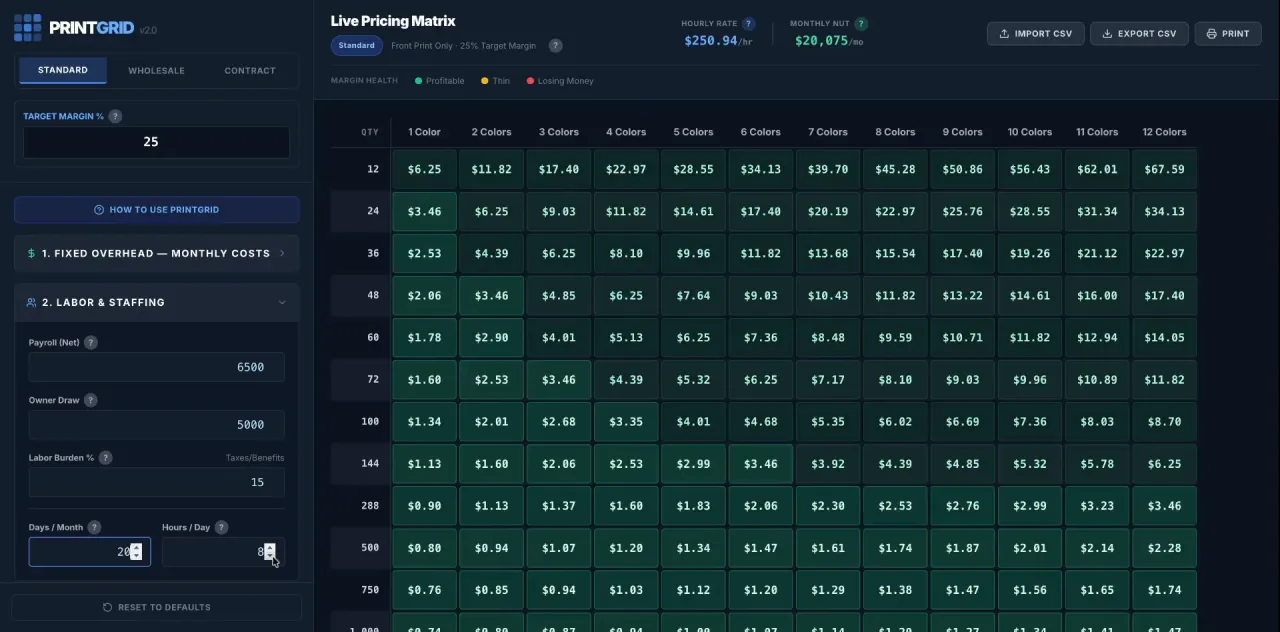
You can build that in a spreadsheet. I did for years, and rebuilt the formulas every time my blank costs moved. That is eventually why I built PrintGrid, a $99 one-time embroidery pricing calculator that also covers screen print, DTF, HTV, and the rest. It takes stitch count, head count, and your own overhead and produces the matrix. It is a calculator and nothing else. No invoicing, no scheduling, no order tracking.
Spreadsheet or embroidery cost calculator, the part that matters is the same. Stitch count and machine minutes drive the number, and your embroidery curve is allowed to look nothing like your screen print curve.
Questions on any of this, hit me direct at ryan@printgrid.ink. Always happy to walk through the math on a call.