Most shops I know price a job one of three ways. They remember what they charged the last guy who ordered something similar. They look at what the shop across town posted on Instagram. Or they open a spreadsheet they built in 2019, do not remember the logic inside it, and trust it anyway.
All three feel fine right up until the year ends and the profit is not there.
The fix is not a new sales strategy. It is knowing what a single shirt actually costs you to put out the door. Once you have that number, the price is arithmetic. Here is how to build it.
The six inputs that make a price
Every real price is built from six things. Most shops track two of them.
1. Blank garment cost. What you pay the supplier, plus freight. Watch the freight, because it does not behave the way the shirts do. A $45 shipping charge is $0.63 a piece across 72 shirts. The same $45 is $1.88 a piece across 24. Freight is fixed per order, so it belongs with your setup costs and not with your per-shirt costs.
2. Ink and consumables. Ink, emulsion, tape, screen wash, reclaim chemicals, pallet adhesive, and the boxes you ship in. Nobody hand-counts this per job. Estimate it as a per-print charge and move on.
3. Screens and setup. Burning a screen, taping it out, registering it on press, and reclaiming it after. This is a fixed cost per color, per location. It does not care whether you print 12 shirts or 1,200.
4. Labor at a real hourly rate. Not what you pay someone. What they cost you. Wage plus payroll tax plus workers comp plus whatever benefits you carry. Take the hourly wage and multiply by about 1.25 to get the loaded rate. Loaded rate means the total hourly cost of employing someone, not the number on their paystub.
5. Overhead per production minute. Rent, utilities, insurance, software, your dryer's gas bill, the truck payment. These costs run whether the press turns or not. Allocating them means dividing that monthly total across the minutes you actually produce, so every job carries its share.
6. Target margin. What you add on top so the business grows instead of just surviving.
The first five give you cost. The sixth turns cost into price.
Getting your overhead rate
This is the step almost everyone skips, and it is the one that finds the missing money.
Add up your fixed monthly costs. Say rent is $2,200, utilities $450, insurance $300, software and phone $250, equipment payments $600. That is $3,800 a month.
Now count your real production minutes. One press, one operator, eight hours a day, twenty days a month. That is 9,600 minutes on paper. But nobody prints for eight straight hours. Between setups, art fixes, and answering the phone, figure 60% utilization. Call it 5,760 productive minutes.
$3,800 divided by 5,760 = $0.66 per production minute.
Write that number down. It applies to every job you run.
The worked example: 72 shirts, 2 colors, one location
Standard job. Front print only, two colors, on a mid-weight blank.
Blank cost. $3.10 per shirt from the supplier. That is $223.20 for 72.
Freight. $45.00 for the shipment. Keep it on its own line instead of folding it into the shirt cost. It does not move when the quantity does, and that matters in a minute.
Screens and setup. Two colors, one location, so two screens. Burning, taping, and reclaiming each screen runs about 20 minutes of labor. At a loaded rate of $25 per hour that is $8.33 per screen in labor. Add $2 in emulsion and chemistry. Call it $10.33 per screen, or $20.66 total.
Press setup. Registering two colors and pulling test prints takes 25 minutes. That is $10.42 in labor. Those 25 minutes also consume overhead: 25 × $0.66 = $16.50. Setup burns $26.92 before a single good shirt exists.
Run time. At 100 pieces per hour on a two-color job, 72 shirts take 43 minutes. Labor is $17.92. Overhead is 43 × $0.66 = $28.38. Run cost is $46.30.
Ink and consumables. Two prints per shirt. Figure $0.06 per print in ink and supplies, so $0.12 per shirt. Across 72 pieces that is $8.64.
Finishing. Folding, counting, boxing. Twenty minutes at loaded labor plus overhead: $8.33 + $13.20 = $21.53.
Now stack it up:
| Line | Cost |
|---|---|
| Blanks (72 × $3.10) | $223.20 |
| Freight (fixed per order) | $45.00 |
| Screens (2 × $10.33) | $20.66 |
| Press setup | $26.92 |
| Run time | $46.30 |
| Ink and consumables | $8.64 |
| Finishing | $21.53 |
| Total cost | $392.25 |
That is $5.45 per shirt to break even. Not to profit. To break even.
Turning cost into price
Now apply margin. Use gross margin, not markup. Gross margin is profit as a percentage of the selling price. Markup is profit as a percentage of cost. They are different numbers and confusing them is how shops end up thin.
The formula is: price = cost ÷ (1 − margin).
At a 45% target margin: $5.45 ÷ 0.55 = $9.91 per shirt. Round to $9.95.
At 50%: $5.45 ÷ 0.50 = $10.90. Call it $10.95.
If you have been quoting this job at $8.50 because that felt about right, you were running a 36% margin and probably telling yourself it was 50%. On a $600 job the gap is small. Across a year it is your entire equipment budget.
What changes when the quantity changes
Setup costs are fixed. Run costs are not. That is the whole reason quantity breaks exist.
Your fixed costs on this job are the two screens, the press setup, and the freight. That is $92.58 that does not care how many shirts you print.
At 72 pieces that bucket works out to $1.29 a shirt. At 24 pieces the same $92.58 becomes $3.86 a shirt. Per-shirt cost climbs to $8.17, and a 45% margin puts the price at $14.95.
At 288 pieces the bucket falls to about $0.55 a shirt, even after freight steps up to $110 for the extra boxes. Per-shirt cost drops to $4.64, price around $8.45.
One caution on those two numbers. They hold the blank at $3.10 across all three quantities, and your supplier will not. Real price breaks push the 24-piece cost higher still, and pull the 288-piece cost lower.
This is why a flat per-shirt price is always wrong somewhere. It is either scaring off the big orders or eating your lunch on the small ones.
Build a screen printing price calculator, not a one-off quote
The trap with all of this is that it is a lot of math to do per job. Nobody sustains that on a Tuesday afternoon with three customers waiting.
The answer is to run the calculation once per configuration and build a matrix. A pricing matrix is a grid: quantity ranges down one side, color counts across the top, and a per-piece price in every cell. You build it once against your real numbers, then quote off the grid in ten seconds.
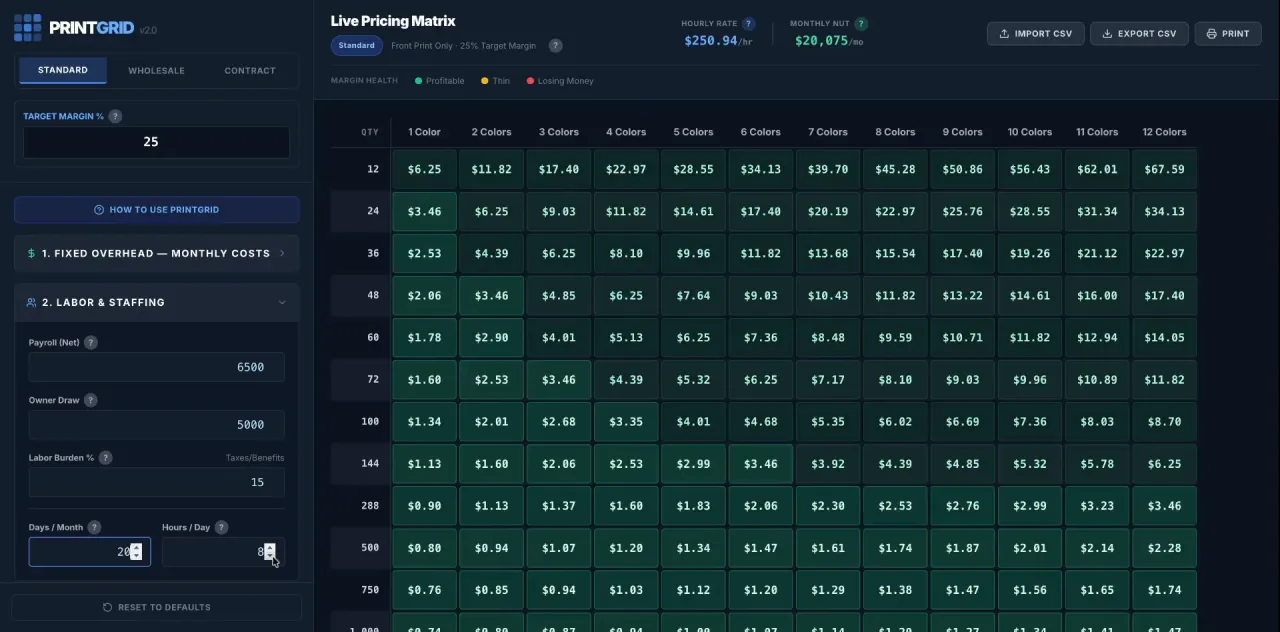
Building that grid by hand in a spreadsheet is genuinely doable, and if you follow the six inputs above you will get a defensible one. It took me a lot of evenings to get mine right, and every time my blank costs or my overhead moved I had to rebuild formulas I had half forgotten. That is why I eventually built PrintGrid. It is a $99 screen printing price calculator that takes these same inputs and builds the matrix for you. It covers screen print, embroidery, DTF, and the rest. It is a calculator, not a shop-management system. It does not touch your invoicing or your scheduling.
Spreadsheet or screen printing pricing calculator, the important part is the same: your price should come from your costs, not from a competitor's Instagram post.
Where to start tomorrow
Pull your last three months of fixed expenses and get your overhead per minute. That one number is the piece nearly every shop is missing, and it is usually the reason the math never added up. Then price your most common job from the ground up and compare it to what you have been charging.
That gets you a base price you trust. Real jobs then pile things on top of it: rush turnarounds, dark garments that need an underbase, customer-supplied blanks, second print locations and reorders. Each one moves the number. I wrote up how I handle every one of those in how to price screen printing jobs when the job is not simple.
If the new number is higher, you have your answer about why the year felt tight.
Questions on any of this, hit me direct at ryan@printgrid.ink. Always happy to walk through the math on a call.