The base cost math is the easy part. You can sit down for an afternoon, work out what a shirt costs you to produce, and come out with a number you trust. I wrote that whole exercise up separately, including the overhead-per-minute step almost nobody does: how to build a screen printing price calculator from your own numbers.
Then a real customer walks in.
They want 36 shirts, not 72. Three of them are on black, so you need an underbase. They brought their own blanks from a trade show. They want a left chest and a full back. And they need it Thursday.
None of that is in your base cost. All of it changes the price. This is the part where most shops start guessing, and guessing is where the margin goes.
Here is how I handle each of these.
Art and setup charges
Two separate things that shops constantly bundle into one line.
Art is design work. Cleaning up a customer's blurry JPEG, redrawing a logo, separating colors. Setup is physical: burning screens, taping them, registering on press.
Art gets billed by time at your loaded rate. Loaded rate is your total hourly cost to employ someone, wage plus payroll tax plus comp, not what shows on their paystub. Mine runs about $25 an hour on the production floor and higher for art. If a customer sends print-ready vector separations, art is zero and you should say so out loud. It builds enormous goodwill and costs you nothing.
If they send a photo of a business card, that is 30 to 45 minutes of real work. Charge for it.
Setup is per screen, per color, per location. Everyone knows this. What shops get wrong is the reorder, so that gets its own section below.
The one time I eat art charges: a customer with a standing order who sends me clean files 90% of the time and one bad one a year. That is a relationship cost, not a pricing decision. Just make sure you know which one you are making.
A second print location is not double the price
The instinct is to double it. That is wrong in both directions.
What actually changes with a second location:
Screens go up one-for-one. A two-color front plus a one-color back is three screens, not two.
Press setup roughly doubles, because you are registering a second job.
Run time does not double. It goes up maybe 30 to 50%, depending on whether you are running both locations on the same pass or reloading the press. Reloading is the expensive version.
Ink and consumables go up by the number of new prints.
Blanks do not change at all.
That last one matters more than anything else. On a $3.10 blank, garment cost is often the largest single line on the job. Doubling the print price when the blank did not move is how you lose the order to a shop doing the math right.
Dark garments and the underbase nobody charges for
An underbase is a layer of white ink printed first, so the colors on top read correctly instead of sinking into a dark shirt. It is standard on anything darker than a light heather.
It costs you two things.
First, it is a color. Extra screen, extra setup, extra ink. Most shops do charge for that.
Second, it needs a flash. A flash is a heater that partially cures the white so the next color does not smear into it. That flash station occupies a head on the press, and it slows the whole run down.
The flash is the part shops forget. A two-color design on white might run 100 pieces an hour. The same design on black, with an underbase and a flash, runs closer to 65. On a 72-piece job that is the difference between 43 minutes and 66 minutes on press. At $25 loaded labor plus $0.66 a minute in overhead, those 23 extra minutes cost about $24.75. Nobody sees that number, because it never appears on an invoice.
So a dark-garment job is a color up and a run speed down. Price both.
Customer-supplied garments
The counterintuitive one. When a customer brings their own blanks, your print price should go up, not down.
You lose the margin on the blanks. That is expected and fine. What people miss is the spoilage. Spoilage is garments ruined in production: a misprint, an ink smear, a shirt that comes off registration.
Normal spoilage runs around 1 to 2%. When you buy the blanks, you order a couple extra and absorb it silently. When the customer supplies exactly 48 shirts and you ruin one, you now have 47 shirts and an angry customer, and there is no replacing it. Their shirts might be from a discontinued run.
You also inherit unknowns. Mixed brands, mixed dye lots, inconsistent sizing, garments that were folded in a hot car for a month. Poly blends you did not spec may need a different ink and a lower cure temp.
My rule: customer-supplied garments get a 15 to 20% higher print price, plus a written spoilage allowance in the quote. Say it plainly: "We are not responsible for up to 2% spoilage on customer-supplied goods, and we need 2 extra pieces per size." If they will not agree to it in writing, that is a real signal about how the job will go.
Rush jobs
A rush is not an overtime problem. Overtime is the cheap part.
The real cost of a rush is that it bumps something else. You had Tuesday planned. Now Tuesday is this job, and the order that was on Tuesday moves to Wednesday, and the Wednesday job is now at risk of being late. You are spending schedule, which is your scarcest thing.
Price it against turnaround, not against effort:
Standard turnaround (say 10 business days): no charge.
Half your standard turnaround: 25%.
Next day or same day, where something else has to physically move: 50%, minimum.
The 50% tier is not greed. It is the price of telling another customer their job slipped. If that feels high, that is the point. A rush fee that never makes anyone flinch is not managing your schedule, it is just a small tip for chaos.
One thing worth doing: apply the rush percentage to the whole job including blanks, because expedited freight is often the actual constraint. A $45 ground shipment that has to become $140 overnight air eats the surcharge on its own.
Reorders should be cheaper, and you should know exactly why
A reorder of the same design on the same garment is genuinely cheaper to produce. Give the customer the benefit, but calculate it instead of eyeballing 20%.
What actually goes away:
Art: gone entirely, assuming files are on hand.
Screen burning: gone if the screens are still in the rack. Most shops hold screens 30 to 90 days.
Press setup: reduced, not gone. You still register the job. You just do not fight it, because you have proven separations and recorded ink and squeegee settings. Call it half.
What does not change at all: blanks, freight, run time, ink, finishing.
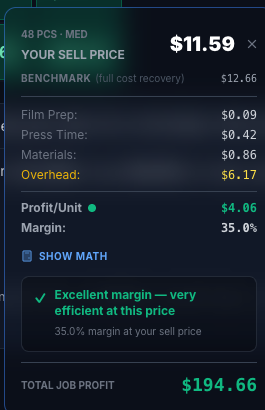
Take the 72-piece example from the calculator post. Screens were $20.66 and press setup was $26.92. On a reorder, screens drop to zero and setup drops to about $13.46. That is $34.12 off a $392.25 job, or $0.47 a shirt. At a 45% margin, a $9.95 shirt becomes about $9.05.
Round it to $8.95 and tell them why. It is a real discount, it is defensible, and it is nowhere near the 20% blanket cut a lot of shops hand out. Twenty percent off would have been $1.99 a shirt against $0.47 in actual savings. That is $110 of your money on one reorder.
If the screens were already reclaimed, it is not a reorder. It is a new job with free art.
When the right answer is no
A job that prices out badly is not a failure of your pricing. It is your pricing working.
The classic trap: 24 shirts, four colors, on customer-supplied goods, needed in three days. Every single factor above is stacked against you. Four screens and four setups spread across 24 pieces. No blank margin. Real spoilage risk on garments you cannot replace. A bumped schedule.
Run that honestly and you land near $17.50 a shirt. The four screens and the four-color setup alone are about $5.40 a shirt in cost, before any margin. Margin takes it to $9.85. The rush adds half again, and customer-supplied goods add another 18% on top. Your customer thinks this job should cost $12. You have three options, and only one of them is bad.
Quote the real number and let them decide. Some will pay it.
Offer an alternative that is actually cheaper to make. One-color instead of four. DTF, which is direct-to-film transfer, printed and heat pressed, with no screens at all. On small multicolor runs it wins on cost regularly.
Or pass, politely, and refer them out.
The bad option is quoting $12 because you want the work. You will do the job, you will spend the schedule, and you will fund the customer's shirts out of your own pocket. Then they will come back, because you are cheap.
Make the judgment calls once, not per quote
Every item here is a multiplier or an adder on top of a base cost. Second location, dark garment, customer goods, rush, reorder. Once you have decided what each is worth in your shop, they stop being judgment calls and become settings.
That is the case for building a matrix instead of quoting job by job. I built PrintGrid for exactly this reason: a $99 one-time calculator that holds these adders alongside your base costs and produces the grid. It handles screen print, embroidery, DTF, HTV, and the rest. It is a calculator and nothing else. No invoicing, no scheduling, no order tracking.
You can do it in a spreadsheet too. The tool matters less than the decision.
Pick your numbers for the six situations above and write them down somewhere your whole shop can see. Then the next time somebody walks in with 36 black shirts they bought themselves and need Thursday, you are not guessing. You are reading.
Questions on any of this, hit me direct at ryan@printgrid.ink. Always happy to walk through the math on a call.